
Concrete Pool Deck Twin Cities: Finishes, Slip Resistance, and Minnesota Freeze-Thaw
Concrete pool deck guide for Twin Cities homeowners — finishes, slip resistance, drainage, joint layout, sealers, and what it takes to build a pool deck that lasts through Minnesota winters.
A pool deck is one of the hardest-working concrete surfaces on any Twin Cities property. It's barefoot in July, buried in snow in January, and soaked in chlorinated water for half the year. Done right, a concrete pool deck in Hugo, MN or anywhere in the Minneapolis–St. Paul metro looks clean and performs for decades. Done wrong, it scales, spalls, and gets slick within a few seasons.
This guide walks through what actually goes into a quality concrete pool deck in Minnesota — finish options, slip resistance, drainage, joint layout, sealers, and the freeze-thaw details that decide how the deck ages. It's written from the perspective of a Twin Cities concrete contractor who pours these every year, not a generic national overview.
Why Concrete Is the Default Pool Deck Material in Minnesota
Concrete handles Minnesota pool decks well for the same reason it handles driveways and patios well here: a properly designed slab with an air-entrained mix, a compacted base, sealed joints, and the right finish stands up to freeze-thaw cycles, snow, chlorinated splashes, and de-icing salts. It also lets the homeowner pick from a wide range of finishes — broom, salt, exposed aggregate, stamped, and colored — without giving up structural performance.
- Long service life — typically 25–30+ years with proper installation and routine sealing
- Wide finish and color options to coordinate with the home and landscape
- Low ongoing maintenance compared with pavers, wood, or composite decking
- Strong slip resistance when the right finish and sealer are specified
- Easy to integrate with patios, walkways, retaining walls, and outdoor kitchens
Pool Deck Finishes That Make Sense for Twin Cities Homes
Finish is where the deck either works barefoot or doesn't. A finish that looks great in a brochure can be miserable in real life if it's too smooth when wet or too aggressive on bare feet. These are the finishes we pour most often around residential pools in the Twin Cities:
Broom finish
Standard, durable, and reliably slip-resistant. A medium-bristle broom finish drawn perpendicular to the pool edge gives strong traction without being abrasive. It's the most common finish on residential pool decks in Minnesota — and the easiest to maintain.
Salt finish
Rock salt is broadcast over fresh concrete, troweled in, then washed out after the slab sets — leaving small pockets across the surface. It looks softer than a broom finish and reads as more textured. Salt finishes are fine in warmer climates, but in Minnesota we prefer a quality broom finish over a salt finish where snow and ice will sit on the deck.
Exposed aggregate
Surface paste is washed away to expose the decorative stone in the mix. Beautiful, slip-resistant, and very durable. It does require excellent base prep and a clean finish technique — and the seasonal cleanup (leaves, debris) takes a little more attention than a smooth broom finish.
Stamped and colored concrete
Stamped patterns and integral or topical color give a pool deck the look of stone, slate, or tile while keeping the structural advantages of concrete. For barefoot pool areas, we recommend lower-relief patterns and a non-slip sealer additive to keep slip resistance high.
If you're considering stamped, our companion guide on stamped concrete patios for Twin Cities homes covers patterns, colors, sealers, and how stamped concrete pairs with pool decks and patios.
Slip Resistance Around a Pool
Pool decks are wet by definition. Slip resistance has to be specified, not assumed. A few practical rules we follow:
- Use a medium broom finish drawn perpendicular to traffic, not a smooth steel-trowel finish
- Add a non-slip aggregate or silica additive to the sealer on smoother finishes
- Keep cross slope at or below 2% so water sheets off without channeling
- Avoid hard transitions, lips, or seams between deck sections at common foot paths
- Re-seal on schedule so the surface texture stays intact instead of polishing smooth
Drainage and Slope Around the Pool
Standing water on a pool deck is the enemy. It freezes, lifts, stains, and accelerates surface wear. A properly graded concrete pool deck sheds water away from the pool coping and away from the house — never back toward either one. On Twin Cities properties with limited fall, we use deck drains, trench drains, or scuppers to move water where it needs to go.
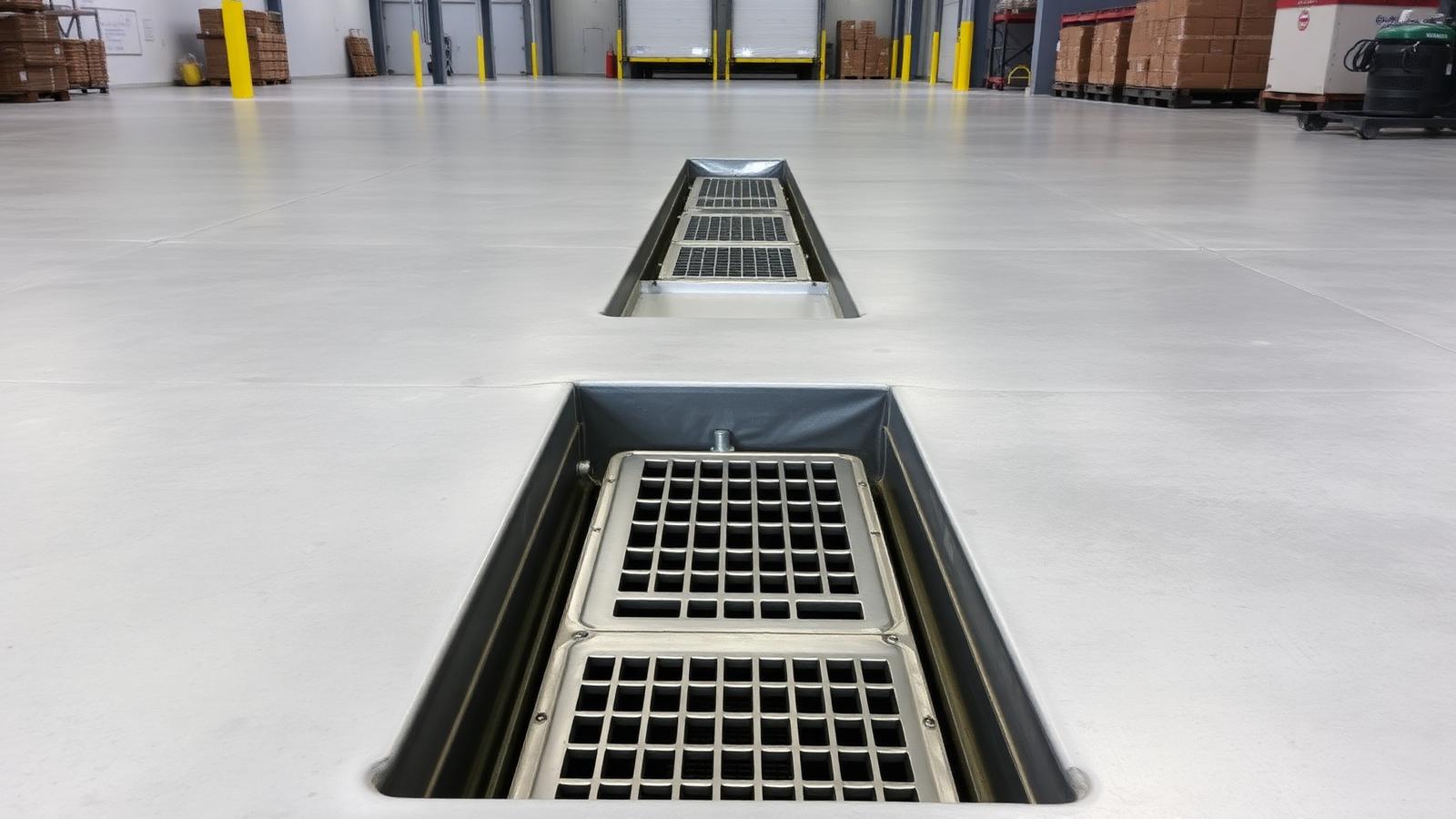
For larger or more complex sites that need engineered drainage, our industrial concrete services group handles trench drains and channel drains that tie cleanly into pool deck flatwork.
Joint Layout: Where Cracks Are Allowed to Happen
Concrete cracks. The question is whether it cracks where you planned for it to (in a tooled or saw-cut joint) or where you didn't (a random surface crack across the most visible part of the deck). On pool decks, we lay out control joints in tight, regular patterns and align them with corners, coping returns, and steps so the joint layout reads as a design element, not a problem to hide.
- Saw-cut joints within 12–24 hours of finishing, depending on weather
- Joint spacing scaled to slab thickness — typically 8–10 ft for a 4–5 inch deck
- Isolation joints at the coping, the house, and any vertical penetration
- Joint sealants that flex with seasonal slab movement
- Re-seal joints every few seasons to keep water out of the base course
Mix Design and Freeze-Thaw Performance
Pool deck concrete in Minnesota has to be specified for cold-climate exposure. That means an air-entrained mix designed for repeated freeze-thaw cycles, a low water-cement ratio for surface durability, and curing that protects the slab during its first week.
The science behind air entrainment and freeze-thaw performance is documented by the Portland Cement Association and the American Concrete Institute — both standard references for serious cold-climate concrete work.
Sealers and Maintenance
A pool deck sealer does two jobs: it protects the surface from chlorinated water, sunscreen, and de-icing salts, and it keeps water out of the slab where freezing would do damage. For Twin Cities pool decks, we use a penetrating sealer that doesn't film over and turn slick when wet, with a non-slip additive where needed.
- Reseal every 3–5 years depending on sun exposure and use
- Rinse the deck down at the end of pool season to clear chlorinated splash
- Keep snow piled in one corner over winter, not the whole deck
- Use sand or pet-safe ice melt — avoid heavy salt the first winter after a new pour
- Address minor cracks and joint sealant gaps early before water gets in
Coordinating the Pool Deck with the Rest of the Yard
A pool deck rarely lives alone. It usually connects to a patio, a walkway from the house, a grill area, and sometimes a hot tub pad. Pouring those at the same time — with matched finishes, colors, and joint layout — costs less and looks better than chasing seams later.
See examples of finished pool decks, patios, and residential flatwork in our project gallery, and review the full scope of our residential concrete services for Twin Cities homes.
Service Area: Hugo, MN and the Twin Cities
L'Allier Concrete Inc. pours concrete pool decks across the Twin Cities — Hugo, Maplewood, White Bear Lake, Forest Lake, Lino Lakes, Blaine, Roseville, Shoreview, Vadnais Heights, Stillwater, Woodbury, Oakdale, North St. Paul, Mounds View, Centerville, Minneapolis, St. Paul, and surrounding communities.
Why L'Allier Concrete Inc. for Your Pool Deck
L'Allier Concrete Inc. has been a concrete contractor in Hugo, MN since 1997. Second-generation, fully insured, and OSHA-compliant — we pour pool decks, patios, driveways, and residential flatwork built for Minnesota winters and Minnesota families, not just for the brochure photo.
Ready to plan a pool deck? Contact us for a free estimate and we'll walk your site, talk through finish options, and put a real plan together.
Explore our work on residential, commercial, and industrial concrete projects across the Twin Cities — or see finished work in our gallery.
Frequently Asked Questions
- How thick should a concrete pool deck be in Minnesota?
- Most residential concrete pool decks in the Twin Cities are poured 4–5 inches thick with reinforcement, over 4–6 inches of compacted Class 5 aggregate. Heavier-use areas or larger spans may step up to 6 inches with engineered reinforcement.
- What is the best finish for a concrete pool deck?
- A medium broom finish is the most reliable choice for a Minnesota pool deck — strong slip resistance, comfortable barefoot, easy to maintain. Exposed aggregate and stamped finishes also work well when paired with a non-slip sealer additive.
- Will a concrete pool deck crack in Minnesota winters?
- Random cracking is largely controlled by proper base prep, an air-entrained mix, and a tight control-joint layout cut on time. Joints give the slab a planned place to relieve stress, so cracking happens at the joint instead of across the surface.
- How often should a concrete pool deck be sealed?
- Typical interval in the Twin Cities is every 3–5 years, depending on sun exposure, splash volume, and de-icer use. Resealing keeps water and chlorinated splash out of the slab and preserves slip resistance.
- Can a stamped concrete pool deck be slip resistant?
- Yes, with the right pattern and sealer. We favor lower-relief stamp patterns around pools and add a non-slip aggregate to the sealer to maintain traction when the deck is wet.
- Should the pool deck and patio be poured at the same time?
- When possible, yes. Pouring connected pool deck, patio, and walkway flatwork at the same time keeps the finish, color, and joint layout consistent, eliminates mismatched seams, and is usually more cost-effective than phased pours.
- Does L'Allier Concrete Inc. install pool decks in the Twin Cities?
- Yes. L'Allier Concrete Inc. is based in Hugo, MN and pours residential concrete pool decks, patios, driveways, and flatwork across the Twin Cities, including Minneapolis, St. Paul, and the surrounding suburbs.
Plan your concrete project with L'Allier Concrete Inc.
Twin Cities concrete specialists with the experience to do it right the first time. Reach out for a walk-through and an honest plan for your project.
Start Your Concrete Project the Right Way
Twin Cities concrete specialists. Free estimates. Built to last.