
Commercial Concrete in Minneapolis & St. Paul: Parking Lots, Sidewalks, ADA Ramps & Curb and Gutter
Commercial concrete contractor serving Minneapolis, St. Paul, and the Twin Cities — parking lots, ADA sidewalks and ramps, curb and gutter, dumpster pads, and flatwork built to code.
Commercial concrete is the part of your property customers, tenants, and inspectors notice first. A clean parking lot, level sidewalks, compliant ADA ramps, and tight curb and gutter signal that a business is well run. Cracked pavement, ponded water, crumbling curbs, and out-of-spec ramps signal the opposite — and they create real liability over time.
If you manage a building, retail center, school, medical office, restaurant, industrial site, or multi-tenant property in Minneapolis, St. Paul, or the surrounding Twin Cities suburbs, the commercial concrete on your site is doing a lot of quiet work — directing traffic, draining stormwater, protecting your foundation, and keeping the public safe. This guide walks through what commercial concrete actually covers, what code and accessibility require, what Minnesota weather demands, and how to choose a commercial concrete contractor that can deliver on all of it.
What Commercial Concrete Includes
Commercial concrete is a broad category. On any given Twin Cities site, it can cover a dozen different surfaces — and each one has its own structural, drainage, and code requirements.
- Commercial parking lots — new construction, replacement, and section repairs
- Concrete curb and gutter — barrier curb, mountable curb, and gutter pans
- ADA-compliant sidewalks, accessible routes, and detectable warning surfaces
- ADA curb ramps and accessible parking access aisles
- Dumpster pads and trash enclosure slabs built for refuse-truck loads
- Loading dock aprons, approach slabs, and trailer pads
- Commercial entries, stoops, landings, and exterior steps
- Bollard footings, light pole bases, and traffic control islands
- Storefront sidewalks, plazas, and pedestrian connections
A serious commercial concrete contractor handles the full scope on one mobilization — instead of leaving you to coordinate three trades for parking, sidewalks, and curb work.
Commercial Parking Lots: Concrete That Earns Its Cost
Concrete commercial parking lots in Minneapolis and St. Paul are built to last. Compared with asphalt, concrete handles point loads from delivery trucks and dumpsters far better, doesn't soften in summer heat, and shrugs off fuel and oil drips that destroy bituminous surfaces. With proper jointing, reinforcement, and base preparation, a commercial concrete parking lot can perform for decades with minimal upkeep.
What goes into a parking lot that actually lasts:
- Subgrade evaluation, excavation, and compacted aggregate base
- Slab thickness sized for stalls, drive aisles, and truck routes
- Reinforcement (rebar, dowels, or fibers) sized to the loading
- Positive drainage to catch basins — no flat zones, no birdbaths
- Joint layout that controls cracking and protects the panel grid
- Air-entrained mix designed for Minnesota freeze-thaw cycles
- Saw-cut joints on time, sealed against water intrusion
- Striping coordinated with ADA stalls, access aisles, and signage
Curb and Gutter: The Drainage Backbone
Curb and gutter does the unglamorous work of keeping stormwater off your asphalt or concrete and into the storm system. When curb is poured by a crew that does it constantly, the line is straight, the gutter flow line is true, and water actually moves where it's supposed to. When it isn't, you get ponding, ice slicks in winter, and pavement that breaks down at the joint.
Common curb and gutter work on Twin Cities commercial sites includes barrier curb for parking perimeters, mountable curb for islands and entries, integral curb and walk, and rebuilt sections where snowplow damage or settling has destroyed the original.
ADA Sidewalks, Ramps, and Accessible Routes
Accessible routes aren't optional. Federal law and Minnesota accessibility code require that public commercial sites provide a continuous accessible path from the public right-of-way, through accessible parking, to every public entrance. The concrete details matter — running slope, cross slope, ramp slope, landings, detectable warning surfaces, and flush transitions are all measured to tight tolerances.
A commercial concrete contractor working on public-facing sites should know the ADA 2010 Standards for Accessible Design inside out — including Section 402 (accessible routes), Section 405 (ramps), and Section 406 (curb ramps and detectable warning surfaces).
Practical ADA concrete details we deliver on commercial sites:
- Sidewalks held at or under 2% cross slope and 5% running slope
- Curb ramps with compliant flares, landings, and transitions
- Truncated dome detectable warning panels at vehicular crossings
- Accessible parking stalls and access aisles poured and striped to spec
- Flush transitions at building entries — no lips or trip hazards
Dumpster Pads, Loading Docks, and Industrial Transitions
Trash and delivery zones are the hardest-working concrete on any commercial property. They take point loads from front-load refuse trucks, scraping from dumpster wheels, and the constant turning of trailers. They have to be poured thicker, jointed differently, and tied into the surrounding pavement so the seam doesn't fail first.
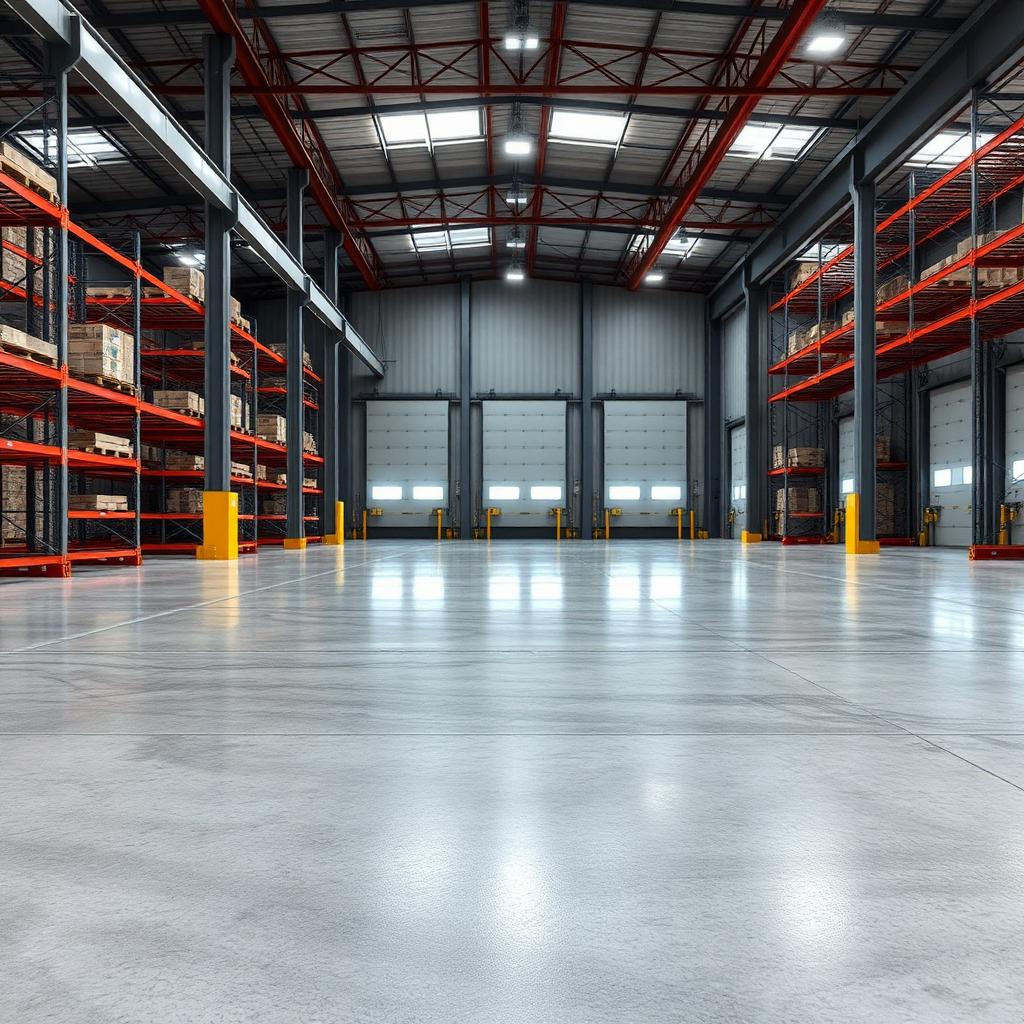
For properties that also need heavier industrial flatwork — warehouse floors, machine base pits, or trench drains — see our industrial concrete services for the full scope.
Why Twin Cities Weather Drives Specification
Minneapolis and St. Paul see deep frost, hard freeze-thaw cycles, heavy snow loads, and aggressive de-icing chemical use every winter. A commercial concrete pour that ignores those realities is a pour with a short clock on it.
- Air-entrained mixes engineered for freeze-thaw durability
- Frost-protected subgrade depths appropriate for the soil
- Joint sealants that flex with seasonal slab movement
- Sealers and finishes that resist chloride attack from de-icers
- Slope and grade that account for snowmelt, not just rain
For background on air entrainment, freeze-thaw performance, and cold-weather concreting, the Portland Cement Association and the American Concrete Institute (ACI) publish the standards that responsible Minnesota commercial work is built around.
Service Area: Minneapolis, St. Paul, and the Twin Cities
L'Allier Concrete Inc. is based in Hugo, MN and pours commercial concrete across the entire Twin Cities metro — Minneapolis, St. Paul, and the surrounding suburbs including Maplewood, White Bear Lake, Forest Lake, Lino Lakes, Blaine, Roseville, Shoreview, Vadnais Heights, Stillwater, Woodbury, Oakdale, North St. Paul, Mounds View, Centerville, and the surrounding communities.
Common project types in our service area include retail and strip center parking lots, medical and dental office sites, school and church campuses, municipal facilities, restaurant and quick-serve sites, industrial parks, multi-family housing, and light industrial buildings.
How to Choose a Commercial Concrete Contractor
A few things separate a real commercial concrete contractor from a residential outfit moonlighting in larger work:
- Fully insured, OSHA-compliant crews trained for commercial job sites
- Real experience with curb and gutter, ADA work, and parking lot layout
- Equipment scaled for large pours, not just residential flatwork
- Coordination with general contractors, civil engineers, and inspectors
- Honest scheduling that respects tenant operations and store hours
- Clean job sites — and clear communication start to finish
If you're vetting contractors, our companion guide on what makes a real concrete specialist walks through the questions to ask before signing anything.
Why L'Allier Concrete Inc. for Commercial Work
L'Allier Concrete Inc. has been a Twin Cities commercial concrete contractor since 1997. We pour parking lots, ADA sidewalks and ramps, curb and gutter, dumpster pads, loading dock aprons, and full commercial flatwork packages for property managers, general contractors, and business owners across Minneapolis and St. Paul. Second-generation, fully insured, OSHA-compliant, and built on referrals.
Learn more about our commercial concrete services, explore our industrial concrete capabilities, browse examples in our project gallery, or contact us to request a free estimate for your Minneapolis or St. Paul commercial concrete project.
Explore our work on residential, commercial, and industrial concrete projects across the Twin Cities — or see finished work in our gallery.
Frequently Asked Questions
- What does a commercial concrete contractor handle?
- Commercial concrete work covers parking lots, curb and gutter, ADA-compliant sidewalks and ramps, dumpster pads, loading dock aprons, storefront walks, light pole bases, and any other concrete flatwork required for a business or commercial property.
- How long does commercial concrete last in Minnesota?
- A properly designed and installed commercial concrete parking lot or sidewalk can perform for 30+ years in the Twin Cities, far longer than asphalt. Longevity depends on subgrade preparation, the right mix design, proper jointing, and routine sealing of joints and surfaces.
- Is concrete or asphalt better for a commercial parking lot?
- Concrete typically wins on lifespan, point-load capacity at dumpsters and truck routes, summer-heat performance, and resistance to fuel and oil. Asphalt has a lower up-front cost but requires more frequent sealcoating, crack filling, and replacement cycles.
- What ADA requirements apply to commercial concrete?
- The 2010 ADA Standards for Accessible Design govern accessible routes, ramps, curb ramps, detectable warnings, and accessible parking stalls. Minnesota commercial sites must provide a continuous accessible path with compliant slopes, landings, and surfaces from the public right-of-way to every public entrance.
- Does L'Allier Concrete Inc. work in Minneapolis and St. Paul?
- Yes. L'Allier Concrete Inc. has been based in Hugo, MN since 1997 and pours commercial concrete across the entire Twin Cities — including Minneapolis, St. Paul, and the surrounding suburbs.
- Can a commercial concrete project happen while the business stays open?
- Often, yes. We routinely phase parking lot replacements, sidewalk work, and curb projects so businesses can stay operational. We coordinate scheduling, traffic control, and temporary access with the property manager or general contractor.
- Do you handle dumpster pads and trash enclosure slabs?
- Yes. Dumpster pads are some of the hardest-working concrete on a commercial site. We pour them thicker, with heavier reinforcement and proper joint detailing, so they handle refuse-truck loading without failing at the seam.
Plan your concrete project with L'Allier Concrete Inc.
Twin Cities concrete specialists with the experience to do it right the first time. Reach out for a walk-through and an honest plan for your project.
Start Your Concrete Project the Right Way
Twin Cities concrete specialists. Free estimates. Built to last.