
Cracked, scaled, or settled concrete garage floor in Minnesota? How to tell repair from replacement, what proper thickness and base prep look like, and what a Twin Cities garage floor pour actually involves.
A garage floor in Minnesota takes more abuse than almost any other slab on a residential property. Vehicles drip road salt and brine through every winter. Snow melts off tires and refreezes in the cracks. The slab moves with the frost. Hot tires lift sealers. After 20 to 40 years, most concrete garage floors in the Twin Cities reach a point where homeowners have to decide between patching what's there and pouring a new floor.
This guide walks through how to tell the difference, what a proper concrete garage floor looks like in Minnesota, and what to expect when the slab needs to come out and be replaced.
Common Problems With Older Garage Floors in the Twin Cities
Most garage floor calls we get fall into a handful of patterns. Knowing which one you're looking at is the first step to deciding repair vs. replacement.
Surface scaling and spalling
Flaking, pitting, and crumbling at the surface — usually worst near the overhead door where salt-laden snow piles up. Light surface scaling can sometimes be overlaid. Deep spalling that exposes aggregate or reinforcement usually signals the slab is at end of life.
Cracks
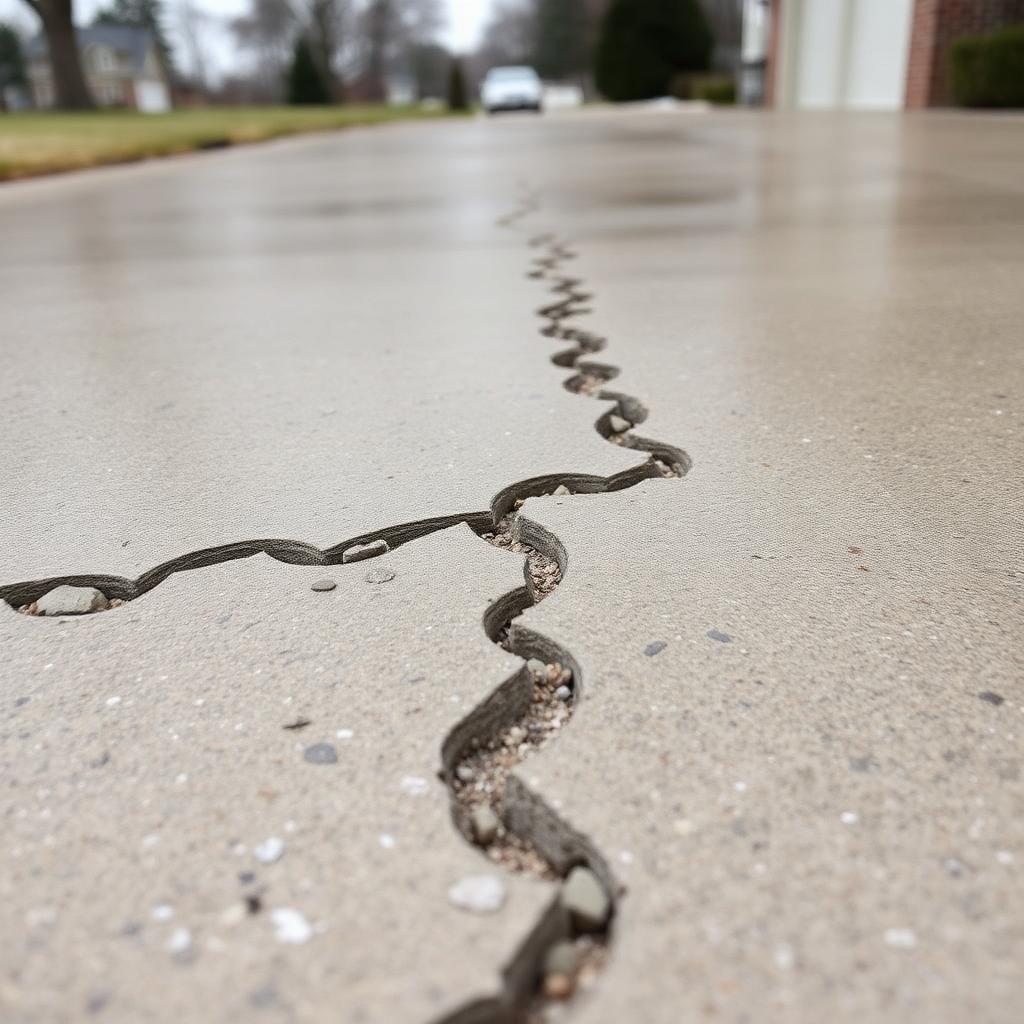
Hairline shrinkage cracks are normal and rarely a structural problem. Wide cracks (over about 1/4 inch), cracks with vertical offset, or cracks that keep growing year over year often mean the base under the slab has failed or the slab was undersized for the loads.
Settlement and heaving
If one section of the floor sits noticeably lower than the rest — or if a section has lifted relative to the foundation wall — you're looking at a base or frost issue. Mudjacking or polyurethane lifting can sometimes restore grade. If the slab is also cracked or scaled, replacement is usually the better long-term spend.
Negative slope and standing water
Older garage floors sometimes slope toward the back of the garage or toward the house instead of out toward the door. Water sitting on the slab accelerates freeze-thaw damage and can rot framing. This isn't fixable with a patch — the floor has to be re-poured at the correct slope.
Repair vs. Replace: How We Make the Call
There's no universal rule, but the questions below cover most decisions:
- Is the damage isolated to one area, or spread across the slab?
- Are cracks moving, or are they stable?
- Is the slab the original thickness for the loads it's carrying today?
- Is the slope still draining water out the door?
- How old is the slab, and how many more winters do you want it to last?
Localized damage on an otherwise sound slab usually points to repair. Widespread scaling, multiple moving cracks, bad slope, or settlement on a 30- to 50-year-old slab usually points to replacement. Spending repair dollars on a floor that's going to fail again in three to five winters is rarely the right call.
What Proper Garage Floor Replacement Looks Like in Minnesota
Demolition and haul-off
The old slab gets saw-cut at the foundation, broken out, and hauled away. Any compromised base material is removed at the same time. Garage door tracks, framing, and adjacent flatwork get protected.
Base preparation
Garage floors live or die on what's under them. We typically strip organics and unsuitable soils, then bring the base up with compacted Class 5 aggregate to a tested depth, graded to drain toward the overhead door. In the Twin Cities, proper base prep is what keeps frost movement from telegraphing through the slab.
Thickness and reinforcement
Most residential garage floors are poured at 4 inches, with thicker slabs where heavier vehicles, lifts, or shop equipment are planned. Reinforcement (rebar, mesh, or fibers) is selected for the loads and slab geometry. Recommended thickness and reinforcement always depend on intended use, soil conditions, and slab dimensions — there isn't a single universal spec.
Joints and slope
Control joints are tooled or saw-cut in a pattern that matches the slab dimensions so shrinkage cracks land where we want them. The slab is finished with positive slope toward the overhead door so meltwater drains out instead of pooling at the back wall.
Finish and curing
Garage floors get a hard troweled finish for cleanability, sometimes with a light broom in the apron area for traction. After finishing, the slab is cured — covered, sealed with a curing compound, or kept damp depending on conditions. Curing time before driving on the floor depends on mix design and weather; we give homeowners a specific window for their pour rather than a generic number.
Salt, Sealers, and Making a New Floor Last in Minnesota
A new garage floor in the Twin Cities is fighting de-icing chemicals and freeze-thaw cycles from day one. A few things make a meaningful difference:
- Let the slab cure fully before applying any sealer.
- Rinse salt and brine off the floor periodically through winter, especially in the first season.
- Use a penetrating sealer designed for freeze-thaw exposure rather than a film-forming coating that can lift under hot tires.
- Keep drainage moving so meltwater doesn't pond on the slab.
These aren't guarantees against cracking — concrete is a structural material that moves — but they meaningfully extend the service life of a properly installed slab.
When to Pour: Timing a Garage Floor in the Twin Cities
Garage floors can be poured any time the ground isn't frozen and temperatures support proper curing. In the Twin Cities, that's typically late April through October, with some flexibility on either end depending on the year. Scheduling earlier in the season generally gives the homeowner more flexibility — late-season slots fill quickly.
Get a Garage Floor Replacement Estimate
We replace residential concrete garage floors across Hugo and the Twin Cities metro. See examples of recent work in our project gallery, read more about our residential concrete services, and request a free estimate when you're ready to talk through your floor.
Related reading: Concrete Scaling and Spalling Repair in Minnesota and Concrete Driveway Cost in Minnesota.
Explore our work on residential, commercial, and industrial concrete projects across the Twin Cities — or see finished work in our gallery.
Frequently Asked Questions
- How thick should a concrete garage floor be in Minnesota?
- Most residential garage floors are poured at 4 inches. Floors that will see heavier vehicles, shop lifts, or trailer storage often step up to 5–6 inches. Final thickness depends on intended use, soil conditions, and slab dimensions — your contractor should specify it after looking at the site.
- Can a cracked concrete garage floor be repaired instead of replaced?
- Sometimes. Stable hairline cracks on an otherwise sound slab can usually be sealed. Wide, moving, or offset cracks — especially combined with scaling, settlement, or bad slope — usually mean the slab has reached the end of its service life and replacement is the better long-term spend.
- How long does a concrete garage floor last in the Twin Cities?
- A properly installed and maintained garage floor in Minnesota commonly lasts 30 years or more. Service life depends on base prep, slab thickness, reinforcement, drainage, and how aggressively salt and meltwater are managed.
- Why is my garage floor scaling near the door?
- Scaling near the overhead door is almost always caused by chloride de-icers carried in on vehicles, combined with freeze-thaw cycles at the slab surface. It's the most common pattern we see in Minnesota garages.
- How long before you can drive on a new garage floor?
- Curing time depends on the mix, temperature, and weather. We give homeowners a specific window for their pour rather than a one-size-fits-all number. Driving too early is one of the fastest ways to damage a new slab.
- Do you have to replace the whole slab, or can you do part of it?
- Partial replacement is possible when damage is clearly isolated and the rest of the slab is in good shape. Where damage is spread across the floor or the base has failed, replacing the full slab usually delivers a better, longer-lasting result.
- What time of year can you pour a new garage floor in Minnesota?
- Generally late April through October, depending on the year and conditions. Slots fill quickly in summer — scheduling earlier in the season gives more flexibility.
Plan your concrete project with L'Allier Concrete Inc.
Twin Cities concrete specialists with the experience to do it right the first time. Reach out for a walk-through and an honest plan for your project.

Start Your Concrete Project the Right Way
Twin Cities concrete specialists. Free estimates. Built to last.